Acoustic Treatment: The Unseen Upgrade
Why taming your room's physical environment yields better results than upgrading your hardware.
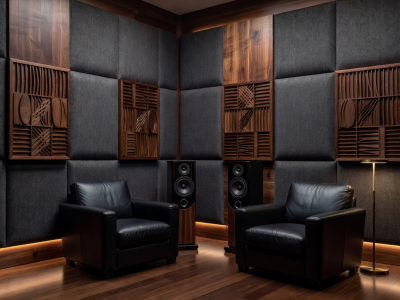
The Room is the Final Component
It is a harsh reality of audio engineering that spending ten thousand dollars on flagship speakers and placing them in an empty, square room with hardwood floors and glass windows will result in an awful listening experience. When a speaker fires, the direct sound hits your ears first, but microseconds later, the sound bouncing off the side walls, ceiling, and floor arrives. This reflected sound causes a phenomenon known as comb filtering—effectively smearing the acoustic image, destroying dialogue intelligibility, and distorting the frequency response.
Acoustic treatment is the practice of selectively absorbing and scattering these sound waves to create a controlled environment. The goal is not to "deaden" the room completely (like an anechoic chamber, which sounds unnatural and oppressive), but to achieve an even decay time across all frequencies, generally targeting an RT60 (reverberation time) of about 0.3 to 0.4 seconds for a home theater.
First Reflection Points: The Starting Line
The most damaging acoustic reflections are the ones that bounce exactly once before hitting your ears. These are known as first reflection points. Taming these is the first step in treating any room.
You can find these points using the "Mirror Trick." Sit in your primary listening position while a friend slides a flat mirror along the side wall. The exact spot on the wall where you can see the reflection of your front left or right speaker is a first reflection point. These points exist on the side walls, the ceiling, and the floor. Placing broadband absorption panels (made of dense rigid fiberglass or mineral wool, typically 2 to 4 inches thick) at these specific locations will drastically clean up dialogue and clarify the soundstage.
Managing Low Frequencies: Bass Traps
High-frequency sound waves are short and easily absorbed by thin foam or curtains. Low-frequency sound waves (bass) are massive, energetic, and completely ignore thin materials. Left unchecked, bass builds up dramatically in the corners of a room, creating resonant modes where certain bass notes ring out loudly for seconds after the speaker has stopped playing.
To control this, you must install Bass Traps. These are thick, highly dense absorbers placed straddling the trihedral corners of the room (where two walls and the ceiling/floor meet). True bass trapping requires mass and volume. Commercial bass traps are often triangular pillars of compressed fiberglass. While they take up floor space, the resulting tight, articulate bass response is impossible to achieve through electronic equalization alone.
Diffusion: Retaining Spatial Energy
If you cover every wall with absorption, the room will sound claustrophobic and lifeless, stripping surround sound of its spaciousness. This is where diffusion comes in. Diffusers are mathematically calculated geometric shapes (often constructed of wooden blocks of varying depths, known as QRD diffusers) designed to scatter sound waves evenly in multiple directions without absorbing their energy.
In a home theater, diffusion is typically applied to the rear wall behind the listening position, and occasionally on the rear portion of the side walls and ceiling. By scattering the sound of the rear surround speakers, diffusers create a vast, immersive "cloud" of ambient sound that makes the room feel acoustically much larger than its physical boundaries.
Balancing the Treatment Plan
A comprehensive room strategy balances all three elements:
- Absorption: Placed at first reflection points (side walls and ceiling) to clarify the front stage.
- Bass Trapping: Stacked in the front and rear corners to tighten low-frequency decay.
- Diffusion: Positioned behind the listener to maintain a lively, enveloping surround field.
By executing this strategy before running your AVR's digital room correction, you allow the electronic EQ to apply minor finishing touches rather than forcing it to fight impossible physics.