Projectors vs. Displays: The Visual Paradigm
Choosing between sheer scale and absolute contrast in your home theater.
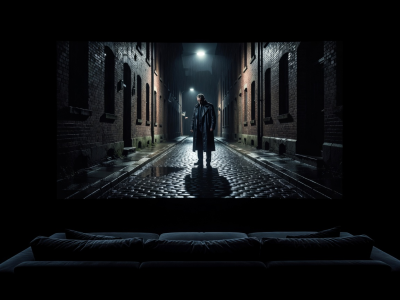
The Scale vs. Contrast Trade-off
The visual anchor of any home theater dictates the design of the entire room. For decades, the rule was simple: if you want a true cinematic experience, you buy a projector. Flat-panel TVs maxed out around 65 inches and were cripplingly expensive at larger sizes. Today, the landscape has radically shifted. High-end OLED and Mini-LED displays are readily available at 77, 83, and even 97 inches, bringing unparalleled dynamic range into the living space.
The choice now boils down to a compromise between two opposing virtues: the immersive, life-sized scale that only a 120-inch to 150-inch projection screen can provide, versus the infinite contrast, blinding HDR specular highlights, and ambient light immunity of an advanced emissive display.
OLED & Mini-LED: The Champions of HDR
High Dynamic Range (HDR) grading is the standard for modern 4K content. HDR relies on extreme differences between the darkest shadows and the brightest highlights (measured in Nits) to create lifelike imagery. Emissive displays like OLED excel here because each individual pixel generates its own light. An OLED can display a blindingly bright star directly next to absolute, pure black space—achieving infinite contrast.
Projectors, by their physical nature, cannot project "black"; they can only project an absence of light. In a room with white walls, the light bounces off the screen, illuminates the room, and washes back onto the screen, raising the black floor to a murky gray. Therefore, an OLED or Mini-LED TV will mathematically outperform any projector in terms of color saturation, HDR highlight punch, and absolute black levels, making them the superior choice for mixed-use media rooms with ambient daylight.
Laser Projection: The Cinematic Standard
Despite the pixel-level superiority of flat panels, a TV cannot replicate the field of view of a commercial cinema. If your goal is immersion—where the screen encompasses your peripheral vision and draws you completely into the film—projection remains the undisputed king.
Modern home theater projectors have moved away from traditional UHP lamps toward solid-state Laser light engines. Lasers provide significantly longer lifespans (often 20,000+ hours with zero degradation), wider color gamuts reaching near full BT.2020 coverage, and rapid power-on times. Technologies like LCoS (Liquid Crystal on Silicon), used heavily by premium brands, offer natively high contrast ratios that, when paired with a light-controlled, velvet-lined room, deliver a breathtaking image.
Ultra-Short Throw (UST) and ALR Screens
A recent revolution in the projection space is the Ultra-Short Throw (UST) projector. These units sit on a credenza just inches from the wall and project a massive 100 to 120-inch image upward. They eliminate the need for complicated ceiling mounts and long HDMI cable runs across the room.
UST projectors are typically paired with specialized Ambient Light Rejecting (ALR) lenticular screens. These screens feature microscopic angled ridges that reflect light coming from below (the projector) directly outward to the viewer, while absorbing overhead ambient room lighting. This combination creates a "Laser TV" experience that provides massive scale while remaining viewable during the daytime.
| Feature | OLED Display | Dedicated Laser Projector | UST "Laser TV" |
|---|---|---|---|
| Max Viable Size | 83" - 97" | 150"+ | 100" - 120" |
| HDR Performance | Flawless (Infinite Contrast) | Good (requires tone-mapping) | Moderate (dependent on ALR) |
| Ambient Light | Excellent | Poor (Requires darkness) | Good (with ALR screen) |
| Installation | Wall Mount / Stand | Ceiling Mount, Long cable runs | Credenza setup, complex alignment |
Ultimately, if you have a dedicated room where you can paint the walls dark and block out all sunlight, a traditional long-throw laser projector provides the most authentic theater replication. If you are outfitting a bright living room, a large OLED will deliver a flawless, vibrant picture under any conditions.