Subwoofers: The Physics of Tactile Audio
Pressurizing your space requires displacement, power, and precise acoustic positioning.
The Displacement Game
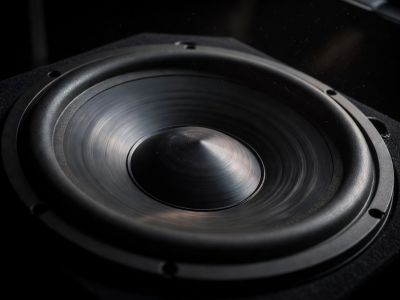
Bass is about moving air. Unlike high frequencies which require very little physical motion to produce loud, piercing sounds, low-frequency sound waves are massive. A 20Hz sound wave is roughly 56 feet long. To recreate the visceral impact of a T-Rex footstep or a cinematic explosion, a subwoofer must act like a massive piston, moving incredible amounts of air very quickly. This is referred to as volumetric displacement.
Displacement is dictated by two factors: the surface area of the driver cone (usually measured in inches like 10", 12", 15", or 18") and excursion (how far forward and backward the cone can travel, often designated as Xmax). A cheap, light driver in a flimsy box will bottom out and distort; a high-end, heavily magnetized driver driven by a robust Class D amplifier will maintain linear motion even under extreme duress.
Sealed vs. Ported Cabinet Designs
The eternal debate in bass reproduction hinges on cabinet design. Both have distinct advantages depending on your primary use case and room volume.
- Sealed Subwoofers: The driver is enclosed in a completely airtight box. The trapped air acts as a spring, providing high restoring force against the cone's movement. This results in incredibly tight, fast, and musical bass, making sealed enclosures favored for critical music listening. Because they lack a vent, they are generally much smaller, satisfying living room aesthetics. However, they are less efficient at the very lowest frequencies.
- Ported (Bass Reflex) Subwoofers: These feature a tuned port (a cylindrical tube or slot) that allows air to enter and exit. At the enclosure's tuning frequency, the air inside the port resonates, dramatically increasing low-end output. Ported subs are vastly superior for home theater use where you need to hit cinematic 15-20Hz rumbles, but the cabinets are significantly larger and heavier.
The Necessity of Dual Subwoofers
The single most profound upgrade you can make to a home theater's low-end is transitioning from one subwoofer to two. This is not about getting "twice as loud"; it is entirely about acoustic physics and standing waves.
In any enclosed rectangular space, low-frequency waves bounce between parallel walls, colliding with each other. Where waves meet in-phase, they create peaks (exaggerated, boomy bass). Where they meet out-of-phase, they cancel each other out, creating nulls (dead zones where you hear almost no bass). A single subwoofer might sound amazing in one seat, but terrible in the seat next to it.
By placing two subwoofers at opposing points in the room (such as mid-points of opposing walls, or opposite diagonal corners), their complex acoustic interaction actively smooths out the room's frequency response across a wider listening area. Dual subwoofers drastically reduce seat-to-seat variation.
Placement Strategies: The Subwoofer Crawl
Because bass wavelengths are so long, placing a subwoofer just a few feet in the wrong direction can trap it in an acoustic null. The "Subwoofer Crawl" is a time-tested technique to find the optimal placement without expensive measurement microphones.
- Place your subwoofer directly in your primary listening chair (yes, right where you sit).
- Play a bass-heavy track or a frequency sweep on a loop.
- Physically crawl around the perimeter of your room, keeping your head near the floor at the height of the subwoofer driver.
- Listen for the spots where the bass sounds tight, punchy, and even. Avoid spots that sound localized, one-note, or hollow.
- Place the subwoofer in the best-sounding spot you found along the wall.
When executing this, remember that corners will naturally boost bass output due to boundary gain (often adding up to +9dB of free output), but this corner loading can sometimes excite all the negative room modes simultaneously, leading to muddy, indistinguishable rumble. Proper placement combined with a receiver's DSP correction will yield the tightest, most accurate cinematic foundation.