Surround Speakers: Creating an Immersive Soundstage
From the foundational center channel to the complexities of 3D spatial audio height effects.
The Center Channel Anchor
The biggest mistake newcomers make when budgeting for a home theater is allocating the majority of their funds to massive left and right tower speakers while skimping on the center channel. In film and television, the center channel is responsible for up to 70% of the audio payload, including almost all on-screen dialogue and center-stage action.
A weak center channel results in "muddy" dialogue, forcing you to constantly adjust the volume between quiet conversations and loud explosions. Ideally, your center channel should be identical to your left and right speakers. Because aesthetic and space constraints usually prevent placing a massive vertical tower directly beneath a television, manufacturers create horizontal center speakers. Look for 3-way center channel designs (with a dedicated midrange driver vertically aligned with the tweeter) rather than basic 2-way MTM (Midwoofer-Tweeter-Midwoofer) designs, which suffer from severe off-axis listening drop-offs due to acoustic lobing.
Timbre Matching the Front Stage
The front three speakers—Left, Center, and Right (LCR)—must be timbre-matched. Timbre refers to the tonal color or unique acoustic fingerprint of a speaker. When a sound effect, such as a car driving horizontally across the screen, pans from the left speaker, through the center, to the right, a mismatch in timbre will make the car's engine sound like it changes abruptly as it crosses the middle of the room.
To guarantee a seamless front soundstage, always purchase your LCR speakers from the same manufacturer, and specifically from the same product line. Surround and height speakers are slightly more forgiving, but keeping the entire ear-level base layer within the same brand is highly recommended.
Floorstanding vs. Bookshelf Speakers
Should your main left and right channels be massive floorstanding "towers" or compact bookshelf speakers mounted on stands? The answer depends heavily on your subwoofer strategy.
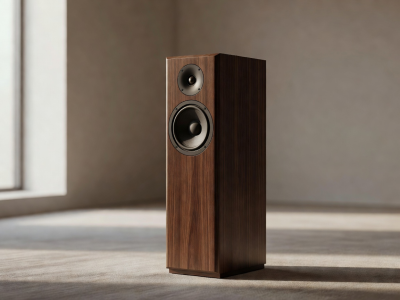
- Floorstanding Speakers: These feature larger cabinets and multiple bass drivers, allowing them to produce deeper low-end frequencies. They are ideal if you listen to a lot of two-channel stereo music without a subwoofer. However, they are more expensive and harder to place.
- Bookshelf Speakers: Because home theater systems rely heavily on dedicated subwoofers for frequencies below 80Hz, large tower speakers often become redundant. High-quality bookshelf speakers paired with capable subwoofers will frequently outperform mid-range tower speakers, as you are offloading the power-hungry low frequencies to the subwoofer's dedicated amplifier.
Surround Placement and Spatial Audio
Base layer surround channels provide ambient sound and directional cues. In a 5.1 setup, surround speakers should actually be placed slightly behind and to the sides of the main listening position (approximately 110 to 120 degrees from front center), not directly beside the listener.
The advent of Dolby Atmos and DTS:X has shifted recommendations for surround speaker types. Previously, diffuse bipolar or dipolar speakers were favored to create a "wall of sound." Today, object-based audio relies on pinpoint precision to place a helicopter hovering exactly over your left shoulder. Direct-radiating (monopole) speakers are now the strict standard for all bed-layer and height channels to maintain accurate imaging.
Height Channels: The Atmos Layer
To achieve true 3D audio, you must add height channels. There are three approaches, ranked from best to worst:
- In-Ceiling Speakers: Flush mounted directly overhead. This provides the exact directional origin intended by sound mixers.
- Height/Elevation Speakers: Mounted high up on the front and rear walls, angled down toward the listener. A highly effective compromise if you cannot cut into ceilings.
- Up-firing Modules: Speakers placed on top of your main towers that bounce sound off the ceiling. Highly dependent on a flat, acoustically reflective ceiling and strict placement geometry; generally considered the least effective method.
Building an immersive layout is an iterative process. Start with an exceptionally strong 3.1 setup, expand to 5.1, and eventually integrate overhead channels for a 5.1.4 or 7.1.4 masterpiece.